Thursday, 4 December 2025

Map On Hold

I'm not good at finishing. I was recently attempting the NovNov challenge and between work commitments and family stresses I didn't get to finish the challenge. I was already falling behind anyway so it wasn't really a surprise that it didn't work out.
This is a pattern in my life. 
I have so many potential campaigns in short notes and in my head that I could be doing nothing but writing and running RPGs for the rest of my life and never run out. Getting them all down on paper would be difficult. The tones don't match for many of them and I have problems switching tone quickly. This would leave me dropping scenes that are too heavy in the middle of light hearted adventures.
What else is stopping me? Well, I'm afraid to succeed. I know, it sounds weird, but I've always had this fear that I would become good enough at something that others would come to depend on me for and I would inevitably disappoint them because...
Yeah, it's imposter syndrome. Hard to avoid.
What on earth does any of this have to do with maps? Well, I'm trying to push myself out of my comfort zone and part of that is forcing myself to finish some things I started long ago. A map for one of my campaign worlds is part of that. The world itself is pretty generic, with a fallen empire in a pseudo-european land with ruins, cities, and wide expanses full of battlefields. The party's jobs is simply to survive and, if possible, make things a little easier. But I found myself with a map for this world that I build from the history. It's not great and needs a little professional input to complete, and so, in order to push myself out of my comfort zone, I'm going to try to find a professional to take it from what I've got to what others will enjoy.
Am I going to write a campaign sourcebook to go along with it? No! There are much better ways to get the most out of campaign world and the templates provided by Daggerheart are a good way to get the most out of it.
I've also backed the Twilight Sword campaign on Backerkit. This has an interesting mechanic for breaking up a region into areas of interest, each with it's own focal points and encounter possibilities. I think combining the two ways of looking at the world will provide a simple way to build a world out from a starting point to a fully fledged campaign setting. Watch this space, I guess.

Wednesday, 26 November 2025

The Templar Variations

 It's amazing having the time and focus to work on my games again. It almost feels like a luxury.

Oh! Wait. That... that is a luxury.

Nevermind.

Anyway, one of the projects that's been on hold is my Templar class.

The Godless Priest

For those who don't know, the Templar was a pseudo-priest introduced in the Dark Sun world that gained power from dedication to a Sorceror King (rulers of the few city states scattered throughout the land).

The original 2nd Edition Templar class picked spells from the Cleric list and had fewer spell slots per day. Most of their "power" other than spells was of a political variety, which was great for RP heavy campaigns, but not for hack and slash style play. Effectively, the Templar was a weak priest until high level.

There was no official 3rd Edition Dark Sun product and the third party offerings were weird if you're kind and straight up racist bullshit if you're not. 2nd Edition was bad enough (all these desert dwellling white folks trying to free the slaves), but the 3rd Edition.. Slave Scent anyone? 

Well, the Templar there was even more RP/NPC focused with a power set that can in no way be viewed as anything other than Evil. It wasn't a good look.

4E brought Dark Sun back, but by this point the Templar had been demoted to a character Theme. This provided a few extra "thematic" powers the character had available when they wished. This did make the character more useful in combat and meant that anyone could be a Templar, irrespective of class. This was a nice addition.

The 4E theme only added powers up to 10th level, so the player would not be bound to their Sorceror King and could focus on whatever they wanted to beyond that point. With Epic Desitinies to focus on, the theme didn't have to be a defining part of the character.

Modern World Interpretations

5E has shook things up again. Despite the recent Apocalyptic Subclasses Unearthed Arcana, there are unlikely to be any plans to introduce a Dark Sun world to 5E as we've seen it before. This is possibly because the community as a whole doesn't seem to have an appetite for the themes introduced in the Dark Sun setting. Slavery, tyranny, the oppression of social class, these are not part of the modern game.

Somehow, as an outsider, this feels very similar to the US Administration removing references to slavery, inequality, and black people from Government websites and from education programs. It smacks of a bad case of whitewashing.

The old narrative, prompted primarily by the artwork, did carry a heavy "white saviour" mentality. That's problematic enough. But is it also problematic to ignore the theme of slavery entirely in our roleplaying games? Or should we be facing up to our place in history?

The Templar represents something we see often in history. Oppressors put systems in place to ensure the hegemony and sometimes even the oppressed will join that system in the hope of affording themselves protection. We shouldn't look away from that, but neither should we celebrate it.

I'll continue to develop my Templar, but I will unapologetically make it as a tool of oppression and the players can decide how they sit with that. Let them tell on themselves.


Monday, 3 November 2025

Unfun

There's an attitude in gaming at the moment of Unfun. It's quite prevelant and I'm not sure I like it. Some of it is justified: racially sensitive content has no place at my table and I would encourage others to think of what it is they are putting out and ask themselves who might be harmed by the story they're telling.


But one thing that gets me is hyper positivity. Having bad things happen to characters is becoming more and more taboo. I've heard people online talking about people retconning entire combats because a character died and they weren't having it.

That doesn't make a lot of sense to me. If you're coming into a game where, canonically, there are creatures that can wipe out an entire town with a breath weapon, then you must accept that there are likely to be creatures that can potentially hurt your party, and maybe even kill them.

Another thing is increasingly frowned upon is "taking away player agency". There are these spells, called enchantment/charm spells, that make people behave in ways they normally wouldn't. They are, by design, supposed to usurp the will, but apparently there are players who complain about this. Why? You get to use those spells too. If you refuse to suffer the consequences, you don't get to use the spell either. There! Enchantment/Charm school is now banned.

And there starts the problem.
I have no problem with removing notions like bio-essentialism. No person is inherently better or worse than another person, and I have no issue with that, and I would also defend never forcing a player to experience something or force their character to act in a way that is likely to be a trigger or a trauma, it remains part of the game that you can be forced into a state of fear by magic.

Expecting everything to go your way all the time feels childish. Avoiding "Unfun" seems like something that should only happen at a kids' table.

Am I the problem?

It could be that I'm missing some Zeitgeist here, but I want my challenge to be challenging in game! That's the important part for me. This is all in game stuff for me. I am going into the dragon breathing, spell casting, monster infested world of dangers. I can't expect to walk out completely unscathed.

Or my character can't. I shouldn't be harmed by something I'm doing in an imaginary space for fun through a proxy character. 

Therefore, neither you

Now, am I saying you shouldn't play that way? Not at all. I think you should run your table how you see fit. But I don't think I'd be comfortable at your table.

Thursday, 23 October 2025

Grim Up North

Yesterday I received the Vaesen starter set and a few books from the Kickstarter. In many ways it's a pretty standard Starter Set with basic rules, character sheets, initiative cards, "what you can do on your turn" cards, a mini bestiary and some handouts for the included adventure. 

The print quality is very good too, with full colour art, glossy covers and a nice feel to the paper. If anything is off-putting it's the shortness of everything. If the basic rules are anything to go by, the main book isn't going to have a lot in it that isn't filler. The adventure comes to 12 pages plus cover.

I'm still looking forward to running it, though. The system is based on d6 rolls and count 6s for levels of success. I'll post again when I can fully describe the experience.

Monday, 22 March 2021

On Not Gaming

 Oh, we've all been there. Life gets complicated. The older you get, the harder it is to organise everything to ensure "fun" happens, and this includes those people who KNOW that fun is important.

My Sunday game was cancelled this week because people's schedules are rarely fixed and life changes all too frequently. Some of it is driven by sensible prioritization: do I prepare for an interview for a promotion or do I go gaming with my mates? Of course you prepare for the interview. Duh!

I'm reminded of the Terry Pratchett quote: "Inside every old person is a young person wondering what happened!"

Sometimes, you just want a break. My Wednesday game was also cancelled because we all chose to spend St. Patrick's Day having fun with our families instead.

Sometimes, not doing something fun is self-care. Never let anyone tell you otherwise.

Wednesday, 17 March 2021

Once Upon a Time...

 ... there was a God. He slept.

The End


Or is it?

Of course not.

Since I was last here, I completed a degree, got a job and took a starring role in a Pandemic. (There are 7.odd billion others who may challenge my claim of a 'starring role', but as I'm the one living THIS life, I stick with my contention and will not back down.)

So, why am I back? Well, why not. The Pandemic rolls on and it could be months yet before life returns to any semblance of "normal". I have already wasted too much of that time on other foolish things, but of late I have sloughed my bad habits, taken up running, and chosen to re-engage with the things that give me joy.

This is one of those things.

No schedules as yet, but once I enter into a rhythm You'll know as well as I. I look forward to speaking to you again.

Thursday, 25 January 2018

The Dread Chaos of Normal Life

I'm finally able to return to playtesting after a short hiatus due to Australian Flu (has there ever been a British Flu, or American Flu?), university work and family commitments. I'm trying to get the balance of individual powers right.

There are few enough combat powers beyond the "cantrips" mentioned in previous articles.
Many seem somewhat utility with a few buffs and temp hit points.
I'm allowing higher level characters to boost the powers by spending multiple influence on individual powers.

So far, the balance seems fair, but this might come down to player comfort with the power level.

For the next two sessions, I'll be doing "shopping episodes", to test out the utility aspects, with the occasional head-to-head with equal level opponents, to see how things stack.

Tuesday, 28 November 2017

It's a Kind of Magic - Templar Powers

When designing the Templar, I wanted an alternative to the standard system of magic used in D&D. I got the feeling that, in order to provide something worthy of attention, it has to be unique. Also, to maintain the flavor of its Dark Sun origins, it had to have something unique to the condition of the power source.
 Effectively a Templar is servant of her patron King. The Templar gains power by obtaining influence with her patron. As I mentioned in the first post on this series, the power of a Templar should be roughly equivalent to a Warlock. To this end, I chose to have the Templar's influence recharge on a short rest. The amount of influence a Templar can bring to bear is equal to their level but there may be addenda in the final outing.
Templar warrior with flaming sword, receiving hawk.

Structure

Powers for the Templar are based on three levels of power. Lesser powers are roughly equivalent to first level spells. It costs one point of influence to manifest a minor power. When you gain higher influence, it is possible to bump up the power to a more effective level (like spending higher spell slots).
 Minor powers are roughly equivalent to second and third level spells. Each costs 3 influence to manifest and can also be buffed up using additional influence.
 Finally, Greater powers are roughly equivalent to fourth and fifth level spells. Each costs seven influence to manifest and can be buffed using additional influence.
 The maximum buff allowed is half your level minutes one. Thus, a fourth level character can only add one buff point to a spell. This prevents a character of lower levels from creating the effects of a higher level spell.

Chide the Mind

Lesser

As a reaction, if any creature hits you with an attack, you can glare at them balefully or shout a curse. The target must make a Wisdom saving throw or suffer 3d6 psychic damage, or half as much on a successful save. For each additional point of influence spent, the damage increases by 2d6.

Monday, 20 November 2017

Raw Power... and Cantrips

wand box with expelliarmus written on it
Signature Spell

I'm working on a revised magic system for use with my Templar class. I want it to be roughly equal in power to the Warlock, but I don't want the schtick of Eldritch Blast being an effective class requirement. In developing my own 'Cantrips', I realised one thing: some of the cantrips are actually really powerful.
I play an Eldritch Knight in my Wednesday night game. While I have a crossbow, I hardly ever use it, because Fire Bolt is 2d10 (my character is 9th level) fire damage over 120 feet and I can use it as an AOO (War Caster), and I can do a bonus weapon attack right after using it as my action, so potentially 4d10 + weapon damage in a single round of combat. Right there and then is my go to ranged weapon.
For the Warlock, Eldritch Blast is the equivalent, mostly because it ties in with so many of the Eldritch Invocations available to the class. It is the signature at-will power for the class. I want my powers to be a little more flexible, but I get the impression that there is one, or maybe two, that will be go-to powers for the class, for example:

Fist of the Templar

Enchantment cantrip

  • Casting Time: 1 action
  • Range: 120 feet
  • Components: V, S
  • Duration: 1 round
You call out to an enemy or wrongdoer to halt and bring your fist into your other palm. A loud sound rings out in an area of 120 feet (perhaps a thunderclap, a gavel pummelling, or a judgement bell tolling once).
You make a ranged spell attack against the target. On a hit, the target takes 1d6 psychic damage and its speed is reduced to 10 feet until the beginning of your next turn.
The cantrip’s damage increases by 1d6 when you reach 5th level (2d6), 11th level (3d6) and 17th level (4d6).
Being able to slow and harm a creature at the same time makes it useful. I'm considering actually upping the damage to a d8, but I'm not sure (suggestions welcome). Many of the powers available to my Templar cause psychic damage, as the focus is imposing the will of the Sorceror/Undying King. So, this features is one I think could become signature, but only if the focus of the campaign is combat centric.
Some of the other features simply come with the note "This feature functions identically to the <name> cantrip." That's easy enough. I know these features come with built in balance.
The only way to know how this will work out in the long term is to monitor. If players testing my Templar class default to these options every time, then perhaps the feature is too powerful. Either that, or I'm not putting together adventures/encounters that provide for use of the other features.
Next time, I'll go into some detail about the magic system. As the characters are at quite low levels, this hasn't been tested robustly yet, so this will be very much a basic introduction.

Sunday, 5 November 2017

Rising Dark(sun)

So, I'm coming over all Dark Sun. Part of my campaign world ruled over by some seemingly immortal rulers in a desert kingdom. There are story reasons for this, but with magical prohibition in effect (story, again), I got to thinking about the old Dark Sun world. Queue Defilers and Templars.

When I read through the Dark Sun setting information for 4e, I found the demotion of Templars to a background gave me pause. I played a Templar when Dark Sun first came out and it really got me flexing my roleplay muscles. The combined magical and political power behnd the class ensured that not every situation was a straight up fight.

I liked the combination, so I went looking around for any 5e implementations. I didn't really find anything I liked so I'm implementing my own. My Alchemist didn't work out so well, I couldn't find a balance between power and durability on that one, but with the Templar I have a clear model to build from and early playtesting is looking good.

Tweak, tweak, tweak for the next few months.

Wednesday, 27 May 2015

But Why Does it Have to Be So HARD?!

Designing classes is not easy!

I can almost hear the chorus of "Oh really? No shit, Sherlock!" going on as people read that opening line, but the difficulty is in the small things. Some things I was able to 'hand wave' away, like, why can an Alchemist only create so many concoctions in a single day. (Because they're extremely volatile chemicals, and you don't have the skill to manage too many at once.)

The hard part is getting the balance between fire power and staying power. First, I decided to have a d6 for the hit die, just like a mage. This makes the Alchemist a bit flimsy in terms of taking a hit, but when I put it up to a d8, they became a bit too tough at lower levels. (Huff!)

Then there was the problem with just how powerful an Alchemist's damaging extracts should be. I tried following the spell damage table in the DMG, but as there are no spell levels to 'level up' the hit effect (without simply making a bottle mage), the fire power gets a bit low. No problem, just up the level a little, or give on-going damage, right? Oh, Hell no. That makes them just too powerful.

I'm toying with the idea of on-going damage again, limited by the level of the Alchemist, and I'll let you know how that goes, but for now, WHY DOES IT HAVE TO BE SO HARD?!

Saturday, 9 May 2015

Never a Dull Moment

Well, I apologise for not having a post out this week and just wanted to explain why. One of the aspects of medieval life that always fascinated me was the problematic relationship between science and religion. Fears of witchcraft may well have been responsible for delays in forwarding medicine, chemistry and biology by centuries, a delay only overcome once the age of enlightenment began.

I can understand why. Let's face it: the only way to really learn about the how the human body works is to cut them up. In societies where the body is a vessel for a soul that becomes an issue. People who want to cut up bodies to learn how they work become abominations. The entire premise to Frankenstein: The Modern Prometheus was the interference of science in natural order. Even using the title "The Modern Prometheus" puts the moral message in its full context: Prometheus was punished by the gods for his 'stolen' knowledge of fire. His pride/hubris was his downfall, whereas, in reality, his only crime was helping his fellow man and removing their dependency on the gods themselves. Arguably, this was a similar situation for medieval scientists.

The most fascinating aspect of science in this age was the position of the alchemist. Alchemy was the first attempt at proper science, with practitioners attempting to properly quantify the nature and substance of what made up the world around us. Few would argue that alchemy was the basis of modern scientific investigation, but the fear of persecution led to a strange mixture of knowledge, faith and superstition that could possibly be seen as an attempt to stay 'in favour' with the church.

This doesn't seem to have any place in the D&D universe: priests follow many and various gods, demons and spirits. Magic users are, while not a 'day-to-day' experience, not either an anomaly, despised and mistrusted by their peers. They can mix with ordinary people and are often called upon to help communities.

The mage who best fits the position of alchemist is the Transmuter. He gets some abilities to alter properties for a short time (Minor Alchemy), the Transmuter's Stone (a poor man's philosopher's stone), and then, at 14th level, Master Transmuter, which comes with a panoply of abilities that match some of the Cliff Notes version of true alchemy.

Pathfinder has an alchemist class, favoured among goblins, that is effectively little more than a reskinned mage with bombs. The idea of an alchemist class is difficult to envision. It shouldn't, to my mind, just be a reskinned mage, but should reflect the essence of alchemy from a historical perspective. Naturally, to be useful in a party and attractive to players, the alchemist needs to have a bit of a wow factor and be able to hold its own in a fight, so some kind of chemical explosiveness is required. That's where the day-to-day stuff comes in, but she should also be able to discover deeper secrets than just what is handy in a tight corner.

So that's where I'm at. I'm trying to design an alchemist that is historical in context, but still useful to a party, and independent of other classes already in D&D. It's in testing, and I'll release it to the world when I can.

Wednesday, 29 April 2015

The Dread Lord Patron

As I said last week, I'm working on some customisations for D&D 5e, and I decided I'd have a go at a Warlock Patron. I like the idea of the Fae patron and thought that something darker might be in order (I think it's obvious the direction my campaign might be going), but as I have no Warlock players at the moment, I haven't had a chance to test this one, but anyone who remembers the Ravenloft Campaign setting should feel right at home with it. What if the Mists are unravelling? What if the masters of the Dread Realms were trying to find agents to help them escape into our world?
Most of the powers are adaptations of existing powers within 5e, except the Avatar of Shadows, which I've adapted from the Heroes of Shadow 4e sourcebook.

The Dread Lord
Through your journeys into the darkness you have been touched by the mind of a prisoner in a dark realm. The lords of The Dread Realms have told you secrets of darkness, and you can use them to punish and manipulate those around you. What promises have you made to these dark masters? Could you be hoping to set them free?
Dread Lords Strahd von Zarovich and Azalin are examples of those who would grant the power of the Shadows to their clients.
Expanded Spell List
The Dread Lord lets you choose from an expanded list of spells when you learn a warlock spell. The following spells are added to the warlock spell list for you.
Dark Lord Expanded Spell List
Spell Level
Spells
1st
fog cloud, wrathful smite
2nd
pass without trace, phantasmal force
3rd
gaseous form, vampiric touch
4th
phantasmal killer, staggering smite
5th
antilife shell, planar binding


Shadow Stealth

Starting at 1st level, your patron bestows upon you the ability to take advantage of dark places to hide yourself. While in dim light or darkness, you can take the Hide action as a bonus action.

Aspect of Shadow

Beginning at 6th level your patron begins to teach you the ways of the Undead. For one round you become incorporeal. You can move through creatures and objects as if they were difficult terrain. However, if you end your turn inside an object or creature you suffer 1d10 force damage.
You cannot use this feature again until you complete a short or long rest.

Fog of Despair

From 10th level on, you begin to feel the touch of the Dread Realm around you all the time. You carry an aura of shadow out to 10 feet. This counts as Light Obscurity. While you are conscious, creatures entering the aura to attack you must make a Charisma Saving Throw against your Warlock Save DC or suffer disadvantage on all attacks they make against you. Additionally, if their attack succeeds, they suffer necrotic damage equal to your Charisma modifier + half your level (rounded down).

Avatar of the Shadows

At 14th level you can summon the power of your Dread Master to aid you in battle. Your skin pales to white and your eyes become pools of darkness. When you strike with a melee attack, you add your Charisma modifier (minimum +1) to your damage and create a 10’ radius sphere centred on the target. All creatures within the Sphere take 1d10 necrotic damage. For each creature affected you recover hit points equal to your Charisma modifier (minimum of 1 per creature).
Once you use this feature, you cannot use it again until you complete a short or long rest.

Wednesday, 22 April 2015

Shadow Domain

Revised: I'm trying to tie in some of the changes recommended by commenters below (with my own flavour, of course).

Revised 27/04/15: Made a few changes to some of the features, particularly the Channel Divinity. In testing seemed a little over powered, but not as much as suspected. Went for a complete revision, but I can recover it to the original if requested. Also clarified the Shadow Guardians spell.

So, I'm trying out my hand at some customisations in 5e and I thought I'd have a go at a domain. I haven't had much chance to playtest this. I've only used it as a Domain for some priests possessed by a shadow being I was using in one of my story arcs. Let me know how you get on if you use it. Is it too powerful/underpowered? Does the motif seem overbearing or have limited usage? Is it something your players want to use?

Shadow Domain

Gods of Darkness, Night, Evil and Death can all grant their followers access to the Domain of Shadow. Often perceived as being gods of trickery, fear, and "dark deeds", gods of this domain can send their followers to spread fear and mistrust, or to protect those whose activities are associated with night and darkness.

SHADOW DOMAIN SPELLS

Cleric Level
Spells
1st
Chill Touch, Blindness/Deafness
3rd
Darkness, Darkvision
5th
Fear, Shadow Guardians (as Spirit Guardians, but the spirits appear as shadows and the damage is cold damage, not radiant or necrotic)
7th
Conjure Shadow Elemental, Shadow Mantle (as Crusaders Mantle, but the damage is cold damage, not Radiant)
9th
Antilife shell, Shadow Walk

Bonus Proficiencies

At 1st level you gain proficiency in and advantage on Dexterity (Stealth) and Charisma (Deception) checks.

Shadow Ward

If you are targeted with an effect that causes necrotic damage, you can use your reaction to gain resistance against the damage and for an additional number of rounds equal to your Wisdom modifier. You may use this feature a number of times equal to your Wisdom modifier (minimum of once). You regain all expended uses when you complete a long rest.

Channel Divinity: Veil of Shadows

Starting at 2nd level, you can use your Channel Divinity to create a "gloom" within 30 feet of you. All enemies within the area must make a Wisdom saving throw against your spell save DC or have disadvantage on their next attack against you. Also, you gain advantage until the effect ends on all attacks against the next enemy within the "gloom" to strike you. The effect lasts for 1 round plus your Wisdom bonus (minimum of 1 round).

Shadow Zone

Beginning at 6th level, you can extend your Shadow Ward out to a radius of 30 feet. All allies within that range gain resistance to necrotic damage for a number of rounds equal to your Wisdom modifier (minimum of 1 round).

Dark Strike

At 8th level you gain the ability to infuse your attacks with the power of shadow. Once on each of your turns when you hit a creature with a weapon attack, you can cause the attack to deal an extra 1d8 necrotic damage. When you reach 14th level, the extra damage increases to 2d8.

The Stuff of Nightmares

Starting at 17th level, you can use your action to activate an aura of shadows that lasts for one minute or until you dismiss it using another action. Each creature of your choice that is within 60 feet of you and must succeed on a Wisdom saving throw against your spell save DC or become frightened for 1 minute. A creature can repeat the saving throw at the end of each of its turns, ending the effect on itself on a success. If a creature’s saving throw is successful or the effect ends for it, the creature is immune to the fear effect for the next 24 hours. The area is considered heavily obscured, thus everyone within is considered to have concealment from everyone except you.
 

Tuesday, 14 April 2015

The 'Corrupting' Effect of Celestials

Over at Dyvers Campaign there's been discussion of the corrupting effects of consorting with Fiendish creatures. I've always liked mechanics like this in games, as it deals with consequences for the players' actions (which I'm a bit of a fan of).

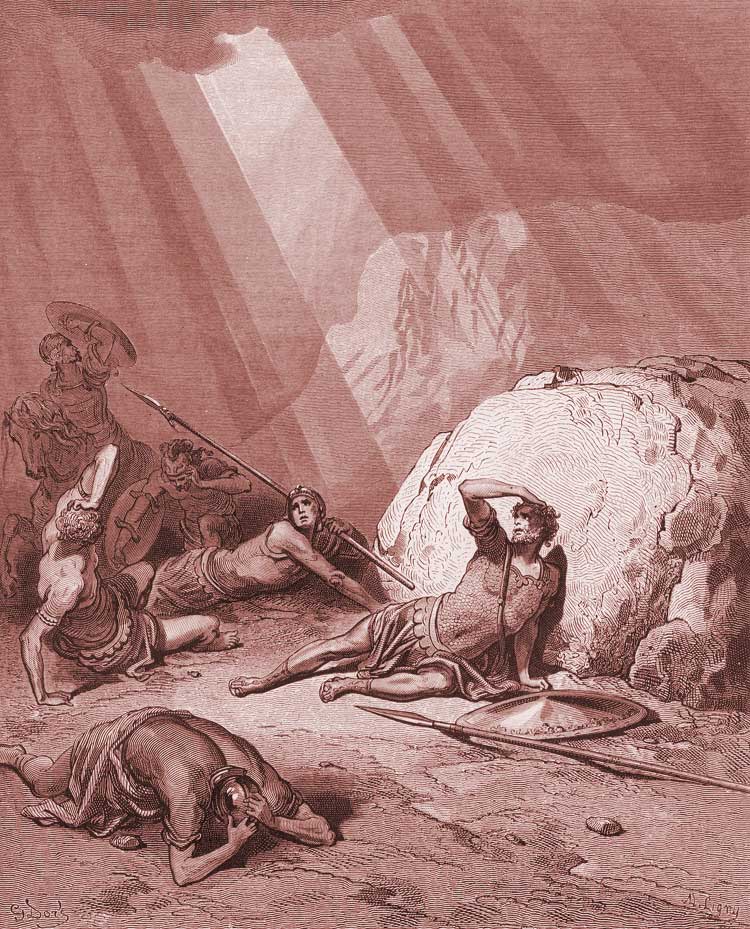
image depicting The Conversion of Saul
The Conversion of Saul
That said, it is always easier to look at these things from the point of view of someone consorting with fiendish characters, but what about characters summoning Celestials to their aid? Are there never to be consequences for this? Surely the presence of a Celestial being is as likely to corrupt the mere mortal soul of a human being? The power that exudes from them must be immense. In Christian mysticism, it is said that to hear the voice of the divine would often render the listener disabled (Saul/Paul was struck blind for three days following his revelation on the road to Damascus).

But, what about long term or frequent exposure to Celestial presence? What would happen if these characters became (for example) completely unable to tell lies? Imagine the chaos that would cause in the court of a corpulent king, who asks if his new robes suit him well.

What if the character couldn't even handle "stolen goods"? How long ago would that have to have been stolen before it was no longer painful to put your hands upon it? What if there was no time limit? A holy relic that was stolen from a temple on far Sphene has been found in the Platinum Hills. Your party can recover it, but for each day it is in your possession, you lost one Hit Die until you return it to its rightful owners. What do you do if they're dead and gone?

I'm not saying that this should be something that prevents characters from ever using summoning spells, but it does make you think that, if a being of raw evil bends the world around them, surely a being of raw good would do the same?

Monday, 28 October 2013

Adventure Report 28/10/2013

OK, so I haven't done one of these for a while and a lot has happened since the last. First, I should say that "The End of 4E" was probably the last real adventure report, as it kind of summed up where we ended the last game.

But here we are, and as my players are now helping me to playtest D&D Next, there is a lot I can't tell you, but here it goes.

The game started with one of the party, our ranger, being summoned by his "handler" to go on a quest. Another of his "brothers" is missing and needs to be tracked down, as he is carrying something very important that needs to be either delivered or recovered. This something is in a satchel with a gold buckle that must not be opened under any circumstances.

The players head off towards the town of Kelbar to track down Orin Selwyn, the missing messenger, or Loklor, the intended recipient of the package. If Loklor has the package, then no harm is done and nobody need worry. If Selwyn is missing with the package, he may be a traitor and must be dispatched. One would assume that this should all be done with reasonable "discretion" ...

... unless they happen to be my players.

Now: in their defence, they are both 10 (the only adult player was not available this week, which made this quest of dubious morality easier to get on with as he plays a paladin). However, I did not expect them to inquire the whereabouts of Loklor from the town guards on the gate, a mistake which resulted in their immediate arrest. The charge was association with known criminals.

After a night in the cells, beside another poor unfortunate who looked as though he'd been set on fire (a thought which they were a little too comfortable with), they got to explain themselves to the guard captain, at which point the ranger told him everything!! That's right: EVERYTHING!!

Of course, the guard captain had the satchel and the poor unfortunate in the next cell was the missing Orin Selwyn whom, the guard captain reveals, was set on fire by none other than Loklor himself. At this point he informs the players that they have one night in town while the storm passes, but must leave by dawn the next day. The players agree and, after a completely uneventful night (I bet you didn't see that coming), they hire a couple of horses and decide to head back to the city to report in to the "handler".


Naturally this isn't going to be easy. As they approach a river they had crossed on the way here, they find it has been collapsed by the storm. The gap is too wide for the horses to jump and the drop to the river too steep and high for the horses to navigate, plus, horse theft is a crime, and if the players don't return the horses to a designated stable at the city they will be accused and potentially hanged.

Returning to the nearest hamlet, they are given two options: go east, up the hills towards a fording point, a shorter path, but one not often taken by travellers, though nobody is sure why; go west, to the lower bridge, which may have survived the storm, but is a longer route.

They decided to go the shorter path, much to my delight, and travel for the rest of the day with little incident. As night begins to fall the spot some house lights through the trees and make for the village. There is nobody in the street and all the doors are closed. Trying the first house, they find it unlocked. Nobody is within and there appears to be signs of a struggle. The second is also unlocked, but when they look into the second room they are attacked by a dog within. The ranger tries to use animal handling to calm the beast, but when he rolls a natural 20 and it still doesn't work, he knows something is wrong.

They force the beast outside and manage to close the doors, but the dog is determined and starts to chew its way through the shutters on one of the windows. By this point, things are getting a little freaky, and the players end up finishing off the dog. Uncomfortable in this house, they move on to the next, which they find locked.

The rogue pops the lock and they enter the building, to find themselves confronted by a human occupant who demands they lock the door immediately, before "the animals come". I overlayed this NPC a bit: she is holding a dinner knife, dirty and dishevelled, refusing to look the players in the eyes. She rants a bit and carries out automatic actions with a quickness that they find discomfitting. It isn't long before they're nervous.


Talking to the woman reveals a few things: the village has changed since "the priests" came. They spoke grandly of protecting the villagers, but then went to the cave to the north. That's when the animals became "possessed". It couldn't have been "the priests" of course, so it must have been soemone else. Conveniently "the priests" come back to town with the bodies of some "intruders". Again the speak of protecting the village and some of the townsfolk agree. That's when the people start to change.

The night is coming and its time for watch. During the first watch, the ranger hears the noise of a great many animals moving around outside, howling, snarling and sniffing at the door. This continues through the night, and one of the players gives the woman a dagger to protect herself with.

As morning dawns, the players go out to investigate and see the town tracked too and fro with animal tracks. They decide to make a break for it, and go to the horses. One has been injured in the night, but they make for the trees. They don't get far before they are being harried by two wolves. Trying to shoot from horseback, they finish one off, but one of the horses becomes panicked and it and the rogue are disappearing off into the trees.

The ranger decides to face off the second wolf. He gets his horse stopped and jumps down, but the wolf manages to finish off the horse! The ranger kills the beast before it can finish him, but realises there are more animals coming through the trees. The only way to go is back to the village.

Meanwhile, the rogue has managed to get her horse back under control, but becomes aware of an approaching bear. She too realises that she is becoming surrounded and the only place to go is back to the village.

As the old woman had promised, they weren't allowed to leave.


As time progresses I took an opportunity to make the players uncomfortable. As I passed behind each player, moving around the table, I would lean in for a moment and whisper a word or two. I would then make them roll a Wisdom save, but not tell them why.

This became invaluable in setting the tone for the rest of the adventure. The players realised that they too were under threat from whatever was affecting the village. The old woman used the term possessed more than once, and this surely affected how the players were now treating the situation. Could they, too, become possessed?

Of course, the answer is yes, but so far they were succeeding their saves, although they didn't know that's what they were doing. Each time I did this, they became a little more paranoid (and I think a little more uncomfortable).

Eventually, I said, just clearly enough, behind the Ranger "Give Up!" Now they were freaked out. He made his save, although he doesn't know that. Things were getting more disconcerting though, and they were genuingely worried that their characters were not going to make it out.


The players decide to face up to whatever it is that has caused this curse. The make their way north, realising that the animals are reluctant to come out of the trees. They surmise (correctly) that the beasts are afraid of daylight, so as long as the sun is up they're safe.

It only takes minutes to get to and through the graveyard, at which point they discover the remains of an encampment. One survivor, a priest of Úisean, comes forward and describes "the priests" who attacked his companions. One wore a strange artifact which writhed with shadows, possibly the source of this difficulty. He has been hiding for some time in a barrow he made for himself, unable to get through the trees to freedom.

The rogue hears the word "MINE!!" in a malicious whisper, but of course, nothing is behind her.

A few minutes later the players are within sight of the cave. The sun is still high, and there are several villagers in the cave mouth. Deciding they don't want to kill hte villagers if they can avoid it, they ask for volunteers to go forwards to speak to them. The priest ends up becoming the volunteer, but as he approaches they charge at him. The arrangement to have the players hidden to provide covering fire becomes the saving grace of the encounter, but the old woman charges forward to attack, fighting ferociously.

The party move on towards the cave. As they enter its shade a creature of living darkness moves forwards and pointing at the rogue says "MINE!!"

This is the creature behind the voice she heard earlier. The old woman attacks, the ranger begins shooting, the priest uses his Sacred Flame and the rogue herself attacks. To add to the tension for her, her rolls suddenly become inexplicably poor. While the others slowly hack away at the creature (which only takes half damage from non-magical attacks) she is unable to harm her tormentor. A convenient fluke for me.

Finally, the beast is put down, although the rogue and priest were rendered unconscious. The ranger used a healing kit to stabilise them and, after a while, they became conscious again. The priest then healed himself, but the rogue had to use her hit die to recover. Despite this, the party pressed on into the cave to face whatever lay ahead.


The players decided that avoiding direct combat with the villagers would be the only way to avoid killing more. They go into stealth mode and begin to search around the cave for "the priests". Eventually they find them, with the head priest, looking a little the worst for wear, sitting in the centre of a ritual, with six others around him, chanting and praying in a language the players don't understand. The rogue does a shortbow sneak attack, while the ranger fires his longbow. Two successful strikes and the Dark Priest is injured. Pressing home their advantage, they go into full attack.Rhino: Stealth Mode

Anything that could go wrong for me at this stage did. The players were pressing home their advantage, and quickly put paid to the Dark Priest. This disabled the villagers, who were moving to join the fray. The acolytes, lasted a little longer than expected, but the old woman's fury put paid to most of them.

With "the priests" dead and the villagers disabled, it was time to look at what to do with the artifact... but that would have to wait.


The outcome of this game was never certain. Again, I made this up on the fly, although it is full of tropes from many sources (but the "mad old woman" is usually a "mad old man"). I hadn't decided to do a scary game, but once I had the idea of possessed animals and people, I just got stuck in. It is kind of tempting to run the follow up on Hallowe'en and really go for broke on the terror level, but the kids are only 10 so I don't want to over do it.

Next rules really help with the fear factor. 1st level characters are really vulnerable compared to 1st level 4e characters. This makes them worth more to my players, not less. They area fraid of losing a character too quickly, and this drive to preserve gives the character more value.

I realised the protagonists were very tough in this game. The shadow creature was based on the wraith, without the long term damage, and I used the Dark Priest from the bestiary for the head honcho. These were two very challenging foes and it was luck of the dice that kept the party alive. The second level was well earned here, and I do hope my players enjoy it. We level up next time, then we deal with whatever dark artifact the priest had.

Sunday, 14 July 2013

Adventure Report 13/07/13

Well, tonight turned out to be one of those adventures where I hadn't quite tidied up properly from last session, but there wouldn't be time to do that and prepare for the next phase of the adventure. What to do in those circumstances?

Wing it!

In a setup that I was completely making up as I went along, the party end up split (NEVER SPLIT THE PARTY!!), with our cleric in a purging ritual which would allow her to recover her powers at long last (assuming she survived) and the two kids' characters making their way back to the city (having no interest in this religious hokum).

Upon reaching the city, the two find out that the Mages' tower, part of the King's castle grounds, has been the target of several recent attacks in search of the tome which details how to use the unusual stone discovered in the earliest adventure. This stone is currently in the hands of the King's half brother, who wishes to overthrow the King and take control of the city of Geredar.

The players are kind of volunteered to be on patrol on their first night, but fail in their duty. Thankfully, their failure was not a catastrophe, as the leader of the tower mages had a decoy tome in place in the library.

But the thieves had access to some powerful magic, allowing them to teleport and create mildly toxic distractions to affect an escape. The one prisoner they manage to keep alive tells htme that the thieves were only hired to get the book and don't care what's in it. Their captain was being paid handsomely for the tome and awaits the return of the thieves on his ship, The Rapahali.

But then, having decided the book was too dangerous and should be destroyed, the players try to use the prisoner to bring the book to them, rather than risk triggering the magical traps protecting it. Despite their precautions, he had kept two trinkets bundle up in this braids, and broke one to blind the players and another to make his escape, presumably to the ship.


What of the priest? Well, after three days of starvation and sleeplessness, she was sent on the last leg of the pilgrimage facing The Mirror, The Voice and finally the Temple.

At The Mirror, a well above the aquaduct they are walking along (see The Silver Skeleton, a previously published D&D adventure from Wizards), she was shown an image of herself in the guise of The Sainted Devil, a reformed succubus they had rescued the previous week. This was a reference to the Devil's innate evil being overcome on the path to redemption.

At The Voice, a cave from which uninitiated echoes feed out into the world, taunting the faithful for their weaknesses and failings, she was mocked for her selfishness, spite and the loneliness of being without her god.

Finally, as she reached the ruins of the Temple at the highest point on the path, she was given weapons and asked to defend the temple, as had Sonnlinor Stoneheart, a stone giant who converted to the faith of Gered in the past. As the dragon rose towards the Temple, she cast herself towards it, with no hope of success, and the flames reached out to consume her.

The players will not know the true outcome of all of this before the next session, which will hopefully be next week.

Monday, 17 June 2013

Adventure Selection

Developing adventures is great fun. Watching players tear them apart? Not so much, but such is the plight of the DM. I've got devils, pirates and carnivorous plants coming over the next few weeks. OH! and a love story. It could get nasty.

Thursday, 18 April 2013

A Deeper History

Well, you may have noticed I'm having a few issues with my blogger link up, so for the mean time I'm going to be posting things manually to this end. I've added a new history article to my site, which you can look at here. Comment here or there to let me know what you think of it.

Monday, 15 April 2013

Upgrade Complete

Well, I wouldn't say it was an ideal crossover and the number of odd breakages, even for a site this small, was incredible, but I'm back. I may have a few issues over the next few days, but hopefully they'll be few and far between.

I decided to take the opportunity to carry out a template update while I was at it. I hope you're all impressed. Again, that might take a little tweaking. Feel free to pass judgement. I won't be offended...